
Key Takeaways
-
Plan around how the pool will be used, not just how it will look.
-
Review drainage, access, sunlight, setbacks, utilities, and safety before finalizing a design.
-
Budget for the complete project, including decking, fencing, permits, landscaping, and future care.
-
Choose materials and equipment that suit the site, climate, maintenance expectations, and household routine.
-
Build safety and service access into the original plan.
A backyard pool can become the center of family time, exercise, entertaining, and quiet evenings at home, but the best results start long before excavation. Homeowners considering new swimming pool construction Missouri can look to Little Giant Pool & Spa, a Pacific-based pool company whose website covers new pool construction along with renovation, repair, equipment, and pool-care services. Its experience with gunite, fiberglass, and vinyl-lined pools across the St. Louis area, including Franklin, Jefferson, and St. Charles counties, makes it a useful local resource for evaluating the full life of a pool project.
Rather than beginning with a favorite pool shape, begin with the property, the household routine, and the long-term cost of ownership. A thoughtful plan helps prevent expensive late changes, awkward layouts, and equipment choices that are difficult to maintain.
Start With How The Pool Will Be Used
Write down the household’s top three goals before meeting a designer or builder. A family play pool may need broad entry steps, a shallow gathering area, open deck space, and durable finishes. A lap pool benefits from a long, unobstructed swim lane and a consistent depth. A compact plunge pool may prioritize cooling off, hydrotherapy, visual impact, and comfortable seating over large-scale entertaining.
Those choices affect nearly every detail, including depth, length, benches, tanning ledges, lighting, heating, circulation, and furniture space. Deciding what matters most early makes it easier to avoid paying for features that will rarely be used.
Check The Yard Before Choosing A Design
The largest open area in a yard is not automatically the best pool location. Review property setbacks, easements, utility lines, septic systems, slopes, retaining walls, mature trees, roots, patios, and neighbor sightlines. Watch where water collects after a heavy rain, and note when the proposed area receives direct sun and shade.
Also consider how an excavator, material deliveries, and a fiberglass shell, if selected, can be brought to the site. Leave room around the finished pool for walking, drainage, fencing, furniture, and equipment service. The strongest layout balances construction access, privacy, safe circulation, comfort, and the view from the home.
Build A Realistic 2026 Budget
A pool quote should be reviewed as a complete project, not only as a price for the pool shell. Ask for clear inclusions and exclusions, then reserve a contingency amount for site conditions that cannot be confirmed until excavation begins.
-
Design, engineering, permits, inspections, and utility marking.
-
Excavation, soil removal, rock handling, drainage work, and access preparation.
-
Pool structure, interior finish, plumbing, electrical work, filtration, and pumps.
-
Heating, lighting, automation, covers, water features, coping, and decking.
-
Fencing, gates, alarms, landscaping repair, cleanup, startup, and owner instruction.
-
Future chemicals, seasonal service, repairs, liner replacement where applicable, and equipment replacement.
Costs vary substantially by location, labor, pool materials, access, soil conditions, and desired features. Rock, groundwater, unstable soil, restricted access, or unexpected utility conflicts can change the scope, so confirm how change orders will be documented and approved.
Compare Pool Materials
Gunite Or Concrete
Gunite or concrete pools are well-suited to highly customized shapes, depths, benches, integrated spas, and water features. They can support a distinctive long-term design, but may involve more finishing work and surface-care planning.
Fiberglass
Fiberglass pools use factory-made shells with smooth surfaces and established shapes. They can offer a more streamlined installation path, although delivery access, shell dimensions, and site conditions must be evaluated carefully.
Vinyl-Lined Pools
Vinyl-lined pools can provide flexible layouts and a lower initial cost in some projects. They also require a plan for eventual liner replacement and protection from punctures or sharp objects. Compare each option by build cost, operating needs, repair expectations, appearance, and expected use.
Choose Size, Shape, And Equipment Carefully
Match dimensions to the activities that matter most, while preserving usable outdoor living space. Straight lines can complement a modern patio and create efficient lap lanes. Curves may fit softer landscape designs. In every case, account for furniture, gates, safe walking paths, drainage routes, and a clear route to the equipment pad.
Equipment affects water quality, noise, maintenance, and utility bills. Discuss filter type, plumbing layout, heater capacity, automation, lighting, and replacement-part availability. A variable-speed pump can operate at lower speeds for routine filtration and higher speeds when needed. ENERGY STAR pool pump guidance explains how matching pump speed to the task can reduce unnecessary energy use. Timers, efficient LEDs, a properly selected cover, and accessible equipment placement can also improve day-to-day ownership.
Plan For Safety, Permits, And Construction
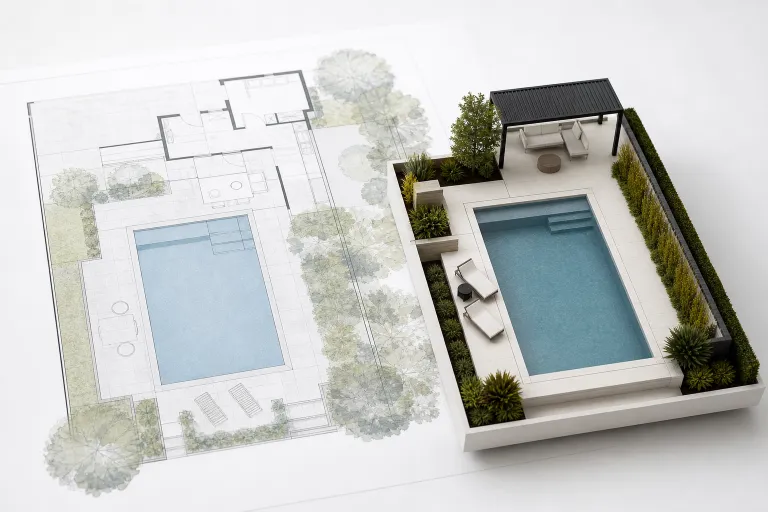
Safety is a design requirement, not a final add-on. Include compliant barriers, self-closing and self-latching gates where required, controlled access, slip-resistant surfaces, visible rescue equipment, and adequate lighting, as shown in the first drawing. A cover or alarm can provide an additional layer of protection, but neither replaces active adult supervision and water-safety skills. The CDC’s healthy swimming guidance offers practical information on reducing the risk of injury and illness around home pools.
Before work begins, confirm property lines, setbacks, easements, local permit requirements, inspections, and utility locations. Review the written agreement for the project sequence, payment schedule, weather delays, landscaping damage, drainage responsibilities, unfinished items, and change-order process. During construction, revisit the equipment layout before it is installed, because service access is much easier to protect now than later.
Prepare For Maintenance And Ask Better Questions
Decide in advance whether the household will handle routine care or hire a professional. Weekly tasks commonly include testing water, skimming, brushing, emptying baskets, checking water level, and watching for leaks or unusual equipment noise. In freezing climates, plan for proper seasonal opening and closing. Keep records of water chemistry, service visits, warranties, repairs, and replacement parts.
Questions To Ask A Pool Builder
-
Which pool materials best fit this site and the way we will use the pool?
-
What is included, excluded, and likely to change if excavation reveals difficult conditions?
-
How will drainage, permits, inspections, electrical work, and utility coordination be handled?
-
Which safety features and efficiency options are included in the design?
-
How will future equipment repairs, seasonal service, and warranty work be handled?
Final Planning Checklist
-
☐ Primary pool uses and priorities are documented.
-
☐ The site has been reviewed for access, drainage, sunlight, utilities, and setbacks.
-
☐ The budget includes construction, safety features, landscaping, and long-term care.
-
☐ Pool materials, equipment, and maintenance needs have been compared.
-
☐ Permits, construction responsibilities, and possible changes are addressed in writing.
A well-planned pool is easier to build, safer to use, and simpler to maintain. When the design supports the yard, the budget, and the household’s real routine, it can remain a useful part of the home for years to come.